












The Writing House — Erasmus+ Project Writing Residency
A focused 30-day residential programme for experienced project writers who need uninterrupted time, professional structure and expert peer support to develop high-quality Erasmus+ proposals for the annual February–March deadlines.
Not another Erasmus+ training — a protected environment in which experienced writers can actually complete their proposals. The residency combines privacy and uninterrupted writing time with enough professional structure to prevent writers from becoming stuck, isolated or overwhelmed before the deadline.
Who is it for?
- Experienced Erasmus+ project writers
- NGO project-development professionals
- University international-relations and research staff
- Consultants writing proposals for clients
- Public-institution project officers
- Education, youth, VET, adult-learning and sport professionals
- Consortium coordinators responsible for the final application
- Freelance writers managing several international proposals
Entry requirements
- Previous Erasmus+ or EU project-writing experience
- A specific Erasmus+ action or call being targeted
- An initial project concept
- Confirmation or strong prospects of a coordinator and consortium
- Organisational authorisation to develop the proposal
- Sufficient professional English
- Access to the required project and partner information
This is not an introductory course for people who have never written a proposal. Less-experienced writers may participate only if working with an established lead writer or with prior preparation.
Residency calendar
| Edition | Approximate period | Best suited for |
|---|---|---|
| Early Calls Residency | Thirty days before early-February deadlines | Mobility, Capacity Building, Jean Monnet, Erasmus Mundus and related actions |
| Partnership Residency | Thirty days before the principal March deadlines | Cooperation Partnerships, Small-scale Partnerships, sport and other March actions |
An optional extension of 7–14 days can be offered for actions with deadlines later in March.
What makes it a residency?
Approximately 70% of the programme is protected individual writing time. The remaining time is divided between individual expert consultations, peer review, proposal clinics, consortium meetings, short wellbeing and recovery practices, and weekly planning and progress reviews. Residents do not attend daily lectures — learning happens through working on real applications.
Programme structure
Before arrival: each selected resident submits a targeted Erasmus+ action and deadline, project concept note, expected consortium, current proposal status, organisational needs analysis, writing objectives, sections of responsibility and areas requiring expert feedback. The resident and programme mentor then establish a realistic 30-day writing plan.
Week 1 — Focus and project architecture: call interpretation and award criteria, eligibility and readiness check, needs and problem analysis, target-group definition, European added value, objectives and intervention logic, consortium roles, proposal development plan. Output: validated concept and complete proposal architecture.
Week 2 — Methodology and implementation: activity and methodology design, work packages, roles and responsibilities, implementation timeline, target groups and participation, inclusion/accessibility/safeguarding, digital/environmental/participation dimensions, quality assurance and monitoring. Output: first complete implementation draft.
Week 3 — Impact and operational coherence: outputs, outcomes and impact, indicators and evidence sources, dissemination/exploitation/sustainability, risk management, partner coordination, budget architecture, coherence review, critical peer review. Output: full first draft with budget structure.
Week 4 — Review, refinement and submission readiness: evaluation against award criteria, relevance and priority check, consistency review, removal of repetition and unsupported claims, partner-feedback integration, final budget and timeline check, language and readability review, completion and submission planning. Output: submission-ready proposal or advanced draft with clearly allocated final actions.
Weekly rhythm
- Silent writing blocks — five days per week
- Morning focus check-in — Monday–Friday, 15 minutes
- Individual mentoring — once per week
- Proposal clinic — twice per week
- Structured peer review — once per week
- Consortium meeting window — twice per week
- Progress review and planning — every Friday
- Unstructured recovery day — once per week
Suggested daily rhythm
- 08:00–09:00 — Breakfast and personal preparation
- 09:00–12:30 — Protected silent writing
- 12:30–14:00 — Lunch and rest
- 14:00–17:00 — Writing, consultation or consortium meetings
- 17:00–18:00 — Walking, movement or decompression
- After 18:00 — Personal time, optional peer exchange
The residency discourages all-night deadline culture. Sustainable focus is part of the methodology.
Expert support
- Four individual consultations of 60 minutes
- Two proposal clinics per week
- One complete structured review of the main proposal
- Feedback based on the official award criteria
- Support with intervention logic and work-package coherence
- Budget-architecture consultation
- Impact and evaluation support
- Final submission-readiness checklist
The mentor does not write the entire application on behalf of the resident.
Peer-review model
With only five residents, each participant receives meaningful interdisciplinary feedback on whether the problem and solution are understandable, whether the project logic is convincing, whether activities realistically lead to results, whether responsibilities are clear, whether the proposal is innovative without becoming unrealistic, and where an evaluator may find gaps or contradictions. Residents retain complete ownership of their ideas and proposals.
What residents receive
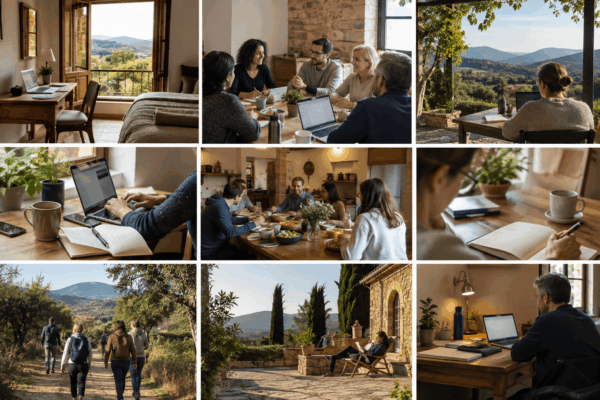
- Approximately 30 nights in a private room
- Dedicated ergonomic writing desk
- Reliable high-speed internet and backup connection
- Access to printing and scanning
- Quiet shared working room
- Private space for consortium calls
- Meals and refreshments
- Pre-residency project-readiness review
- Structured writing plan
- Four individual consultations
- Proposal clinics and peer review
- Templates and quality-control tools
- One full proposal review
- Weekly wellbeing or nature-based activity
- Post-residency online follow-up
- Certificate of professional residency
Practical infrastructure
- Private bedrooms
- Separate or acoustically protected workstations
- Strong internet with a backup system
- Uninterrupted electricity or backup power
- Heating and suitable working temperature
- Ergonomic chairs and adequate lighting
- Printing, scanning and stationery
- Scheduled meals that do not interrupt writing
- Access to nature and safe walking space
- Reasonable access to healthcare and transportation
- Clear quiet-hour and visitor policies
“Isolated” means protected from everyday distractions — not unsafe or disconnected from essential services.
Expected results
- One submission-ready or substantially completed application
- Validated project logic
- Complete activity and work-package structure
- Implementation timeline
- Consortium responsibility matrix
- Monitoring and evaluation framework
- Impact, dissemination and sustainability plan
- Budget architecture
- Risk-management framework
- Final quality and submission checklist
Funding approval cannot be guaranteed.
Confidentiality and intellectual property
All residents sign a residency agreement covering confidentiality of project concepts, ownership of proposals and materials, responsible use of peer feedback, prohibition of copying another resident’s concept, management of potentially competing applications, data protection, disclosure of conflicts of interest, and optional mutual non-disclosure agreements. Applications are reviewed before admission to avoid placing direct competitors targeting the same topic and call in the same cohort without their informed agreement.
Pricing
| Option | Price |
|---|---|
| Early-bird, 30-day residency | €2,400 |
| Regular, 30-day residency | €2,700 |
| Additional 7-day extension | €550 |
| Additional 14-day extension | €950 |
The price includes accommodation, meals, workspace and the professional programme. Travel, insurance and personal expenses are not included. A reduced self-funded rate or one subsidised place per cohort may be offered to independent NGO writers.
Application and booking process
- Submit an online application
- Provide a concept note and identify the targeted call
- Participate in a 30-minute suitability interview
- Receive confirmation and proposed residency period
- Sign the confidentiality and residency agreement
A minimum of three accepted residents is recommended for the edition to proceed.
What is not included
- Guaranteed funding approval
- Complete proposal writing by PORAKA NOVA
- Automatic access to project partners
- Legal or financial certification
- Final organisational authorisation
- Formal eligibility confirmation from a National Agency or EACEA
- Proposal submission on behalf of the applicant
- Translation of the full application
- Travel and personal insurance
Participants remain responsible for verifying all conditions in the official Programme Guide and submitting their applications through the correct platform.